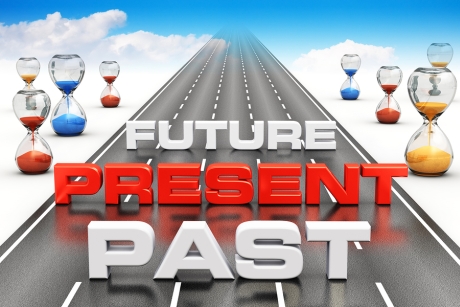

You may have been led to believe that in order to indicate a specific English grammar tense, you HAVE to conjugate verbs and actually USE that particular grammar tense.
Well, guess what?
It’s not always the case!
In conversational English it’s more than possible to refer to the future or the past without using those specific English tenses and without conjugating the corresponding verbs.
And here’s an example to clearly illustrate what exactly I’m talking about here.
Let’s take, for example, the following sentence: “I’m planning to visit my friend tomorrow.”
Now tell me please what is the grammar tense we can observe in this sentence? It’s Present Continuous – “I’m planning” – isn’t that right?
Yes, that’s right!
And now, tell me please what you’re actually referring to – present or future – in this particular sentence?
Before answering the question, just let me draw your attention to the fact that if we’re looking at the sentence purely from a grammar standpoint, it is indeed the Present Continuous Tense you can observe, that’s right.
But here’s the question you have to ask yourself: “Am I really emphasizing the fact that I’m MAKING PLANS at this particular moment in time or am I stressing the fact that I’m visiting my friend TOMORROW?”
So, are you referring to the present or the future in this particular sentence?
Of course it’s FUTURE!
You’re using Present Continuous to refer to a FUTURE event so the take-home lesson is:
There are situations when you don’t have to use the corresponding grammar tenses to refer to the future or the past!
And now, just to provide you with a deeper insight into the whole thing, let me give you a number of phrases and expressions to be used in your English conversations.
It’s going to save you time and effort trying to figure out the right English grammar tense to use – instead you can just learn those phrases and use them when a fitting occasion arises!

SLEEP WELL? – this is a typical English phrase used when greeting someone in the morning, and it’s a great example of how you don’t necessarily have to use the corresponding English Tense – in this case it’s the Past Tense – to ask a question.
Let’s say, for example, you’re on a business trip with some of your work colleagues, you checked into a hotel the night before, and now you’re meeting one of your colleagues at the breakfast table.
“Hey! SLEEP WELL?” – this is a typical thing to ask, and you don’t necessarily have to use the Past Tense to ask the question about the past – “DID YOU sleep well?”

BE RIGHT BACK! – if you’re about to leave for a few moments to attend to some urgent matter and you want to tell the other person you’ll be back in a moment, this is how you can say it: “BE RIGHT BACK!”
You don’t necessarily have to use the Future Tense – “I’ll be right back” – you can simply skip the “I’ll” part and reduce this phrase to just 3 words – “BE RIGHT BACK!”

I’M ABOUT TO – this is an English phrase when you can talk about your future intentions without using any of the Future Tenses – GOING TO or WILL Future forms.
This particular phrase is used when talking about your immediate intentions; basically it’s when you’re on the verge of doing something: “Listen, I’m about to do something very stupid, but I don’t think I have a choice. I’m planning to quit my job!”
Basically instead of saying – “Listen, I’m going to do something very stupid…” you can say “I’m about to do something very stupid” – and here’s a couple of more ways of using this phrase:
- I think I’M ABOUT TO marry the wrong person…
- Did you hear there’s a suicidal person on the roof of a hotel downtown? HE’S ABOUT TO jump any moment!
- Listen, I can’t stand him anymore, I’M ABOUT TO snap any moment!

IT’S ABOUT TIME WE + Verb in the Past Tense – now it’s getting even more interesting! This particular phrase where the main verb is in the Past Tense actually refers to the speaker’s wish regarding the FUTURE!
“It’s about time you went outside, you’ve been spending too much time indoors!”
Just look at it from the grammar perspective – “… you WENT” – it’s Simple Past, right?
When used in this particular content, though, “WENT” doesn’t refer to past, it indicates your intentions in relation to the other person’s FUTURE actions!
But in case you’re wondering WHY you have to conjugate the verb in the Past Tense in this particular phrase – here’s my simple answer: “Don’t think about it!” Simply accept it and make sure to learn such and similar phrases for using in your English conversations:
- IT’S ABOUT TIME we changED something around the workplace, it’s too boring!
- IT’S ABOUT TIME I startED working out, I’ve been putting on too much weight lately!
- IT’S ABOUT TIME we DID something to improve our relationship!

WHEN ARE WE / ARE YOU / AM I + Verb –ing Form – there was a time when I always used the WILL Future form when asking questions in relation to future events, for example: “When WILL we meet our friends? We haven’t seen them for such a long time!”
Now I know only too well that I don’t HAVE to use the typical WILL Future form when asking similar questions – life is so much easier if you just use the Present Progressive “When ARE we MEETING our friends? We haven’t seen them for such a long time!”
And here’s a few useful phrases for you:
- WHEN ARE WE GOING on holidays? You promised we would go this year!
- WHEN ARE YOU GETTING your promotion? You’ve been talking about it for months, but there’s nothing happening!
- WHEN ARE YOU COMING home? You’ve been living in the States for so long, your family is missing you!
Basically the take-home lesson is – when starting a question with the word “WHEN”, you don’t have to use the WILL Future form. Just go with the Present Continuous and you’ll be fine!
By the way, speaking of starting a sentence with the conjunction WHEN and also IF, it’s worth pointing out that whenever you’re referring to a FUTURE ACTION, you have to use SIMPLE PRESENT after those words (WHEN and IF) instead of the WILL Future Tense:
- WHEN I’M HOME, I’ll call you! instead of WHEN I’LL BE HOME, I’ll call you!
- IF HE SHOWS UP, tell him I had to leave earlier! instead of IF HE’LL SHOW UP, tell him I had to leave earlier!
It’s just that I know for a fact many of us, foreigners, have the tendency of translating directly from our native language when speaking in English, and many foreign languages demand the verb to be conjugated in the Future Tense after the words WHEN and IF.
It’s not the case with the English language, and the way I see it, it actually makes it easier to speak.
Robby
P.S. Would you like to find out why I’m highlighting some of the text in red? Read this article and you’ll learn why it’s so important to learn idiomatic expressions and how it will help you to improve your spoken English!
P.S.S. Are you serious about your spoken English improvement? Check out my English Harmony System HERE!



Found some good stuff to use in my communication..
You’re welcome my friend!
Hi Robby, it’s nice the way you teach english, thanks